

Product Development
Some problems can't be solved by tweaking what already exists. They need something built from scratch with behavioural science baked into every decision from day one. Not as a "nice to have" feature.
We develop products using behavioural design principles that solve real problems for real humans.
OUR FLAGSHIP PRODUCT
FebriSol: Adherence By Design
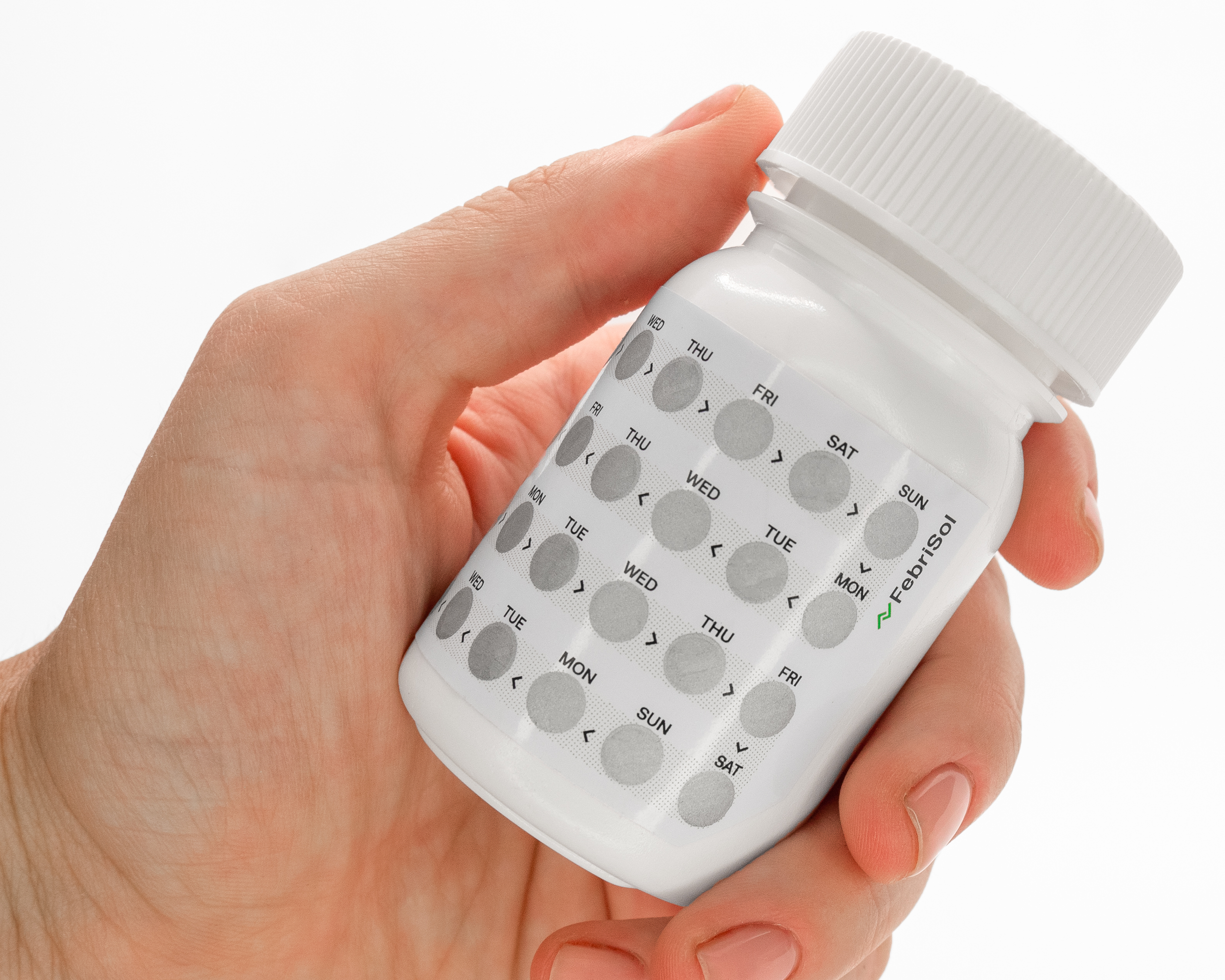
FebriSol is our proof that behavioural design can solve massive public health challenges without massive budgets. It's a scratch-off medication tracking sticker that helps people stick to chronic medication using behavioural science, not technology.
The problem: Around 50% of people on chronic medication don't take it consistently. They want to, but remembering daily medication is difficult.
Why it works: FebriSol removes memory load, creates a satisfying micro habit through tactile feedback, stays visible on the packaging you use daily, and costs a fraction of traditional solutions.
The impact: Over 850 000 units sold internationally. Currently under formal evaluation, with early results showing significant improvements in adherence rates.
Learn more about FebriSol | Partner with us on distribution
Building New Behavioural Design Solutions
Got a problem that needs a new solution built from scratch? We work from initial concept through prototyping, user testing, and market launch.
Our products are grounded in behavioural science from day one, which means they're designed for how real people behave, not how we think they might.
Our Product Development Process:
-
Most product briefs focus on features. We start with behaviour. What do people currently do? What do you need them to do instead? What are the behavioural barriers stopping them? What would make the new behaviour easier than the old one?
We spend time here because getting this wrong means building the wrong thing. We use behavioural science frameworks to understand the gap between current behaviour and desired behaviour. -
We research how the target behaviour works in context. Not through surveys asking people what they'd hypothetically do. Through observation, interviews, and studying how people actually behave in the real world.
We look for: When and where the behaviour currently happens? What triggers it or prevents it? What habits or routines it's competing with? What cognitive load is involved? What environmental factors help or hinder it?
This research phase often reveals that the problem you think you have isn't actually the problem. That's valuable to know before you build anything. -
We develop concepts grounded in different behavioural science principles. Maybe one uses implementation intentions to help people plan when they'll use the product. Another uses social proof to leverage what others are doing. A third uses friction reduction to make the desired behaviour absurdly easy.
We sketch, prototype cheaply, and test concepts with real users quickly. We're looking for what resonates behaviourally, not what looks pretty in a presentation. -
Once we have a concept that works in theory, we build it and test whether it works in practice. We measure actual behaviour change, not just whether people say they like it.
Does it reduce friction? Does it create the habit loop we designed for? Do people use it once or keep using it? Does it work in the messy real world or only in ideal conditions? We iterate based on what we learn.Most products go through multiple rounds of testing and refinement before they're ready.
-
We launch small before we launch big. Pilot with a limited group, measure behaviour change rigorously, refine based on what we learn, then scale. This approach means you're not betting the entire budget on an untested product. You're building evidence that it works before you commit fully.
-
Even after launch, we keep measuring and refining. Behaviour change products need ongoing optimisation.
What works for early adopters might not work for late adopters. Habits that stick in month one might fade by month three. We design for long term behaviour change, not just initial uptake.
When to Invest in Behavioural Design
You have a clear behaviour change challenge. You know what people currently do, you know what you need them to do instead, and the gap is costing you or them significantly.
Existing solutions aren't working. You've tried other approaches, and they haven't delivered the behaviour change you need. Or there simply isn't a solution that works for your specific context.
You're willing to invest in evidence-based development. Behavioural products require research, testing, and iteration. They don't work if you skip straight to building without understanding the behaviour first.
You have a scalable distribution model. The best behavioural design product in the world doesn't help if no one uses it. You need a way to get it into users' hands at scale.
You're focused on long term behaviour change, not short term engagement. Engagement metrics are easy to game. Sustained behaviour change is hard. If you care about the latter, behavioural product development is for you.



Products We Design & Develop:
Habit formation products: Tools that help people build and maintain new habits. Medication adherence, exercise, saving money, learning, and productivity. If the goal is to turn a one-off action into a consistent behaviour, we can design for that.
Decision aids: Products that help people make better choices in complex situations. These use behavioural economics principles like choice architecture to guide people toward decisions that align with their goals.
Behaviour tracking and feedback systems: Tools that help people see their own behaviour patterns and give them feedback that motivates change. We design using including feedback loops, loss aversion, and goal setting.
Nudge interventions: Physical or digital products that make the desired behaviour the easiest choice. Could be as simple as a better-designed form or as complex as a redesigned environment.
Process simplification tools: Products that take complex multi-step processes and make them manageable through behavioural design. Breaking big goals into tiny steps and reducing cognitive load.
Social behaviour change products: Tools that leverage social norms, social proof, and community to influence behaviour. These work particularly well for behaviours where what others do matters.